And then there are the vegetables

My winter planning is continuing, although it is now becoming spring planning. I’ve had some feedback that my “thoughts on sustainable agriculture” post was depressing. I didn’t mean it to be sad, just realistic.

However, I feel I need to follow-up on that post. At the time of its writing, I had been planning on leaving the vegetables to concentrate more on honey. Vegetables are a lot of work and worry for very little profit, if any. But as the weather has been warming up I’ve realized I love growing vegetables. This will only be my fourth year but already I don’t know what to do with my spring if I’m not planning for my vegetable fields. Maybe I’m spring-crazed or maybe it’s because the hours at my other job are reduced for April and I suddenly have more time, but I don’t care anymore what my returns are for vegetable production. It’s just so wonderful to be growing veggies for people, spending time in the dirt, with only the birds calling in the trees and my dog lying on the compost pile watching everything I do.

So I will be growing all sorts of vegetables again this year. I even have a market stall at a market in Edmonton, which means you’ll be able to easily access my farm’s products! I won’t tell you where yet because it’s not 100% confirmed.

On a slightly different train of thought, I went to a market gardening workshop in September on Salt Spring Island. One sentence really stuck with me- “nobody should be growing vegetables for other people. Everyone should be growing their own vegetables. Farmers should be growing meat, eggs, honey and other livestock products that urban people do not have the space nor permission to produce.” Not all urban folks can grow their own vegetables either, but this is a sentiment I agree with. Everyone who has the interest, space and capability should have their own garden. I will try to integrate this idea into my farm however I can. I’m still thinking on ways I can do so.

(And about not being allowed to keep chickens or honey bees in the city-  just do it anyway! Bylaws shouldn’t be allowed to dictate our ability to be food secure.) But I didn’t say that. Nor do I keep chickens in town…

The Dead Hive Mystery

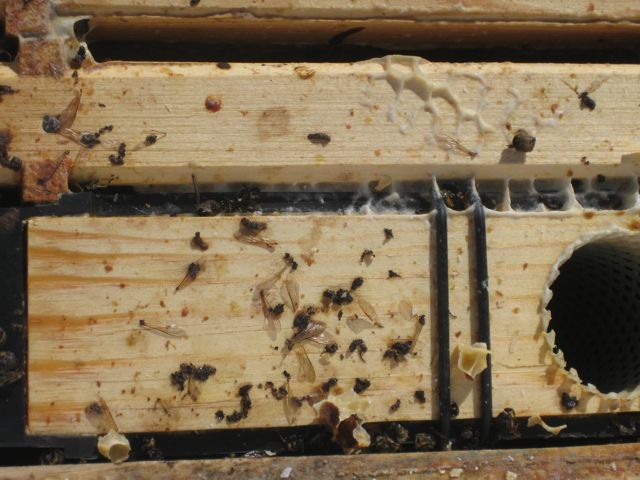
The weather has been warm and sunny for the last few days. Coincidentally, I’m also working fewer hours at my day job so I had an opportunity to check my hives yesterday. I’ve known for a few weeks that one of my hives died and that one was still alive. But yesterday I took the time to open up the dead hive to see what happened. Here is what I saw:

Dead Hive

Before I explain the photo, I will describe how bees overwinter. Bees do not hibernate- they remain active all winter, eating honey to give them energy and shivering to stay warm. They form a tight ball, or cluster, to conserve heat. In the centre of the cluster the temperature is usually around 32C. Beekeepers often put insulation around the hives so the bees do not need to work as hard to stay warm and to protect from sudden swings in temperature. Bees can go a long time without defecating in the winter, but they need to take cleansing flights occassionally. Defecating in the hive is unsanitary and can spread diseases so honey bees will not do it unless something is wrong.

Successfully overwintering a hive is the most challenging part of beekeeping (in my opinion). If a colony is in tip-top shape, with plenty of bees, plenty of food, and no illnesses or weakened immune systems, and if the winter weather is favourable, a colony will live. If one or two of those variables are not optimal, the chances of a colony surviving winter are lessened.

And now to the photo. All those brown specks are bee poo, which should not be in the hive. You can see the remnants of the frozen cluster in the upper left, just beside the shadow. I didn’t take off the top box to look at the bottom one; the cluster may extend down and become larger. To my surprise, there was lots of honey still in the combs. I had assumed they had starved but apparently something else happened. There were also many dead bees immediately outside the hive. Figuring out what went wrong is a bit like a detective mystery.

My best guess is that the bees got dysentry. Dysentry is not a disease in itself, it is symptom. It simply means the bees got diarrhea because they were eating something that was hard for them to digest. The sugar syrup I fed them this fall to help them build up their winter food stores may have fermented, which can cause dysentry.

But that’s just a guess. I’m not really sure what happened. I was also surprised that there were so many bee parts, rather than whole dead bees. Maybe the bees were carrying dead bees out of the hive and in the process the bees were falling apart, being frozen and brittle. If anyone has any suggestions on what happened to my hive over the winter feel free to leave a comment.