Presentation on the weekend & the birds return

We’re well into spring now, with the rain this week! So far I’ve planted carrots,  beans, potatoes, three types of swiss chard, five types of peas, four types of specialty beets and two types of spinach. I’m excited to see what the beets look like when they’re beautifully bunched together. I planted most things last week and then we were all sitting waiting for some moisture.

A big thanks to the folks who came out and helped plant potatoes! It would have taken ages if I were out there on my own.

Yesterday I planted a cover crop of buckwheat, wheat and rye. The rye should keep the weeds suppressed (and hopefully will not become a weed itself), as should the wheat. The buckwheat will add lots of organic matter to the soil when I till it in. I’m also hoping it will be flowering at a time when not many other plants are flowering (mid-late July) so I’ll be able to get some buckwheat honey.

Other recent news: I now have five new bee hives! If all continues to go well I should have plenty of honey for the Terwillegar market this summer.

And there are more birds arriving by the day. So far there is a pair of American Kestrels setting up a summer home in an old woodpecker nest in a dead poplar tree. Some people might dislike standing dead trees, but if it means I get a first hand look at a breeding pair of kestrels out of my cabin’s loft window I’m all for them.

There is also a gang of yellow-bellied sapsuckers claiming the yard as their territory. One male drums all morning on an old chimney pipe (he’s the loudest) and the other drums on the powerpole twenty feet away. They’ve taken turns chasing at least one female, who mews like a sick cat. Between them and all the other birds, the yard is a pretty exciting place to be these days.

The only unwelcome visitors are the mice! I think it was an ideal winter for mice, what with all the snow, and there are more mice out there than I could have imagined possible. One ate all but two of my melons yesterday. Yes, I was growing melons. They were happy little plants but a mouse came along and ate off all their leaves so now they’re just stubs sticking out of the potting soil. I’ll keep the two or three I still have and maybe I’ll start more but probably not because it’s getting a bit late for melons.

The biggest (most intimidating?) news for this week is that I’ll be giving a talk for the South Edmonton Vegetarian & Gardening Club on the weekend about the contents of the Canadian organic standards and what we could ask farmers at farmers markets about how they grow their food. I’m doing it without powerpoint, in a workshop style format, which is a new style of presenting for me so I hope it goes okay!

If you’re planning on coming, please think about what prompts you to buy food from farmer’s markets. Between all of us, I’m sure there are a million reasons, which we will be brainstorming at the beginning of the talk/workshop. You can find more info here.

The Dead Hive Mystery, Part 2.

A few weeks ago I posted that my favorite hive, the one that made lots of honey last year, had died over the winter. At the time I didn’t have a good idea of what happened. My best guess was that the bees got dysentry, possibly from eating fermented sugar syrup. I think I’ve now come up with a better guess of what happened, thanks to the help of a couple of bee folks who know way more than I do.

Apparently fermeneted sugar syrup was probably not the problem because that would have made them sick right away, when they initially digested the syrup while filling the combs for the winter. Judging by how little food they ate from the combs, they probably died in November, so they made it past any bad syrup I may have fed them.

There is another salient observation about the hive: the cluster was split into two groups, one on the left side of the top box and another on the right side of the lower box. Apparently this is fairly unusual and indicative of a problem with the queen.

The folks-who-know-more-than-me wouldn’t even guess at what killed the colony until I mentioned the hive had been superceding in the fall. Sometimes a hive isn’t happy with their queen. When this happens, they will start rearing another queen, which is called superceding. This doesn’t always work and if the old queen is dying when the supercedure fails, the colony can end up without a queen. Without her pheremones to keep all the bees together and organized, the hive will die over the winter. I’ve been told those two pieces of information- the attempted supercedure in the fall and the split cluster in the hive- indicate there’s a pretty good chance the colony died because it was queenless.

Although sad, it’s good to know the colony probably didn’t die from a disease that I mis-managed. If I had more experience I may have noticed they were queenless going into winter but who knows. And I still don’t know for sure that’s what happened but it’s the best guess I have right now.

For those who are interested, the other hive is still doing really well. They’ve been bringing in lots of pollen so everything looks great.

And in a couple weeks I will be welcoming five new hives to the Beanstalk! I’ll post about their arrival when the time comes. I’ll have six or seven hives this summer, which probably won’t be enough to provide everyone who would like honey with some, but with my level of experience I’m cautious about getting much more than that.

And then there are the vegetables

My winter planning is continuing, although it is now becoming spring planning. I’ve had some feedback that my “thoughts on sustainable agriculture” post was depressing. I didn’t mean it to be sad, just realistic.

However, I feel I need to follow-up on that post. At the time of its writing, I had been planning on leaving the vegetables to concentrate more on honey. Vegetables are a lot of work and worry for very little profit, if any. But as the weather has been warming up I’ve realized I love growing vegetables. This will only be my fourth year but already I don’t know what to do with my spring if I’m not planning for my vegetable fields. Maybe I’m spring-crazed or maybe it’s because the hours at my other job are reduced for April and I suddenly have more time, but I don’t care anymore what my returns are for vegetable production. It’s just so wonderful to be growing veggies for people, spending time in the dirt, with only the birds calling in the trees and my dog lying on the compost pile watching everything I do.

So I will be growing all sorts of vegetables again this year. I even have a market stall at a market in Edmonton, which means you’ll be able to easily access my farm’s products! I won’t tell you where yet because it’s not 100% confirmed.

On a slightly different train of thought, I went to a market gardening workshop in September on Salt Spring Island. One sentence really stuck with me- “nobody should be growing vegetables for other people. Everyone should be growing their own vegetables. Farmers should be growing meat, eggs, honey and other livestock products that urban people do not have the space nor permission to produce.” Not all urban folks can grow their own vegetables either, but this is a sentiment I agree with. Everyone who has the interest, space and capability should have their own garden. I will try to integrate this idea into my farm however I can. I’m still thinking on ways I can do so.

(And about not being allowed to keep chickens or honey bees in the city-  just do it anyway! Bylaws shouldn’t be allowed to dictate our ability to be food secure.) But I didn’t say that. Nor do I keep chickens in town…

The Dead Hive Mystery

The weather has been warm and sunny for the last few days. Coincidentally, I’m also working fewer hours at my day job so I had an opportunity to check my hives yesterday. I’ve known for a few weeks that one of my hives died and that one was still alive. But yesterday I took the time to open up the dead hive to see what happened. Here is what I saw:

Dead Hive

Before I explain the photo, I will describe how bees overwinter. Bees do not hibernate- they remain active all winter, eating honey to give them energy and shivering to stay warm. They form a tight ball, or cluster, to conserve heat. In the centre of the cluster the temperature is usually around 32C. Beekeepers often put insulation around the hives so the bees do not need to work as hard to stay warm and to protect from sudden swings in temperature. Bees can go a long time without defecating in the winter, but they need to take cleansing flights occassionally. Defecating in the hive is unsanitary and can spread diseases so honey bees will not do it unless something is wrong.

Successfully overwintering a hive is the most challenging part of beekeeping (in my opinion). If a colony is in tip-top shape, with plenty of bees, plenty of food, and no illnesses or weakened immune systems, and if the winter weather is favourable, a colony will live. If one or two of those variables are not optimal, the chances of a colony surviving winter are lessened.

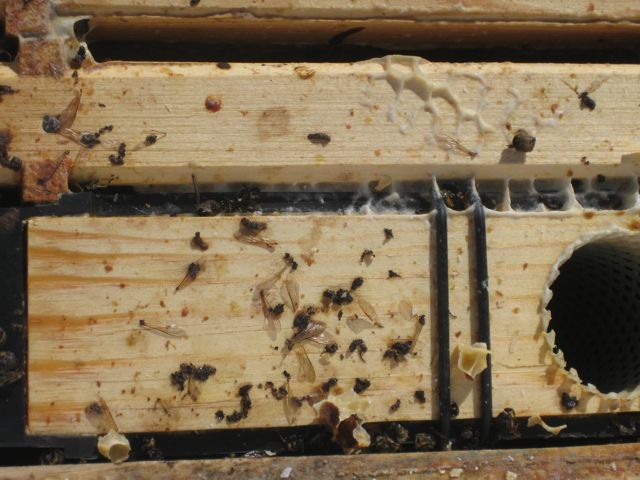
And now to the photo. All those brown specks are bee poo, which should not be in the hive. You can see the remnants of the frozen cluster in the upper left, just beside the shadow. I didn’t take off the top box to look at the bottom one; the cluster may extend down and become larger. To my surprise, there was lots of honey still in the combs. I had assumed they had starved but apparently something else happened. There were also many dead bees immediately outside the hive. Figuring out what went wrong is a bit like a detective mystery.

My best guess is that the bees got dysentry. Dysentry is not a disease in itself, it is symptom. It simply means the bees got diarrhea because they were eating something that was hard for them to digest. The sugar syrup I fed them this fall to help them build up their winter food stores may have fermented, which can cause dysentry.

But that’s just a guess. I’m not really sure what happened. I was also surprised that there were so many bee parts, rather than whole dead bees. Maybe the bees were carrying dead bees out of the hive and in the process the bees were falling apart, being frozen and brittle. If anyone has any suggestions on what happened to my hive over the winter feel free to leave a comment.

Thoughts on Sustainable Agriculture

farmyard

This is the little cabin we were working on building in the fall. It’s not done so we are not living in it yet. We were lucky to even get the exterior done in time for winter!

One of my beehives. I’ve never overwintered bees before so I don’t know if this set-up will work. It’s 1” foam board held over two brood chambers with a black strap. I put the inner hive cover over them, then stacked the unpainted box ontop, filling it with dead leaves. I put the outer hive cover over the dead leaves. There is still heat coming out of both hives so I guess the bees are doing okay. We’ll see how they look come springtime.

As winter is progressing towards spring (I am writing this while listening to the wind howl outside my window in Alaska), I have been thinking about the nature of “sustainable agriculture,” and specifically “small scale, sustainable agriculture.” I find myself coming back again and again to the two main aspects of “sustainable:” agriculture must be both ecologically and financially sound in order to be sustainable. Last summer I realized that small-scale vegetable production can be ecologically sound, but I’m not convinced it is financially sustainable.

I simply cannot figure out how to run a small-scale vegetable farm without accumulating copious amounts of debt and/or working myself to death. Tractors, tractor implements, greenhouses, seed starting supplies, irrigation equipment, quality hand tools, a truck, cold storage facilities, washing and processing equipment… the list of capital one requires to begin and operate a small-scale vegetable farm goes on and on. This doesn’t even include the cost of land, which I’ve been lucky enough to not have to pay. To date I’ve managed to invest in little of the above, but I have been substituting these with my labour and I’ve been operating at a ridiculously small scale because of my lack of investment.

I have recently calculated my expected returns if I were to operate a 30 member CSA next summer. With my current level of capitalization (ie a rototiller, a hoop house, a precision seeder, a drip irrigation system and some hand tools) I figure 30 members is the maximum number of families for whom I can possibly grow food. And that would be A LOT of work.

If I charged $400 per share I would make just $12 000 (30 members x $400). If my expenses were $6000, that works out to an hourly wage of $5.00 ($6000/(50hrs*24wks)). I am not interested in spending six months of my life growing food for 30 families for a personal return of $6000.  That would not even cover my living expenses.

If I increased my level of mechanization substantially I could grow food for, say, 90 members. Ninety members at $400 per share would be $36 000, a more respectable revenue. But then I would be working more months per year and I would need at least one employee and all the capital expenses required to operate at that size (most notably a tractor and implements). I suspect that 90 members is still not a large enough scale to provide me with a real income.

These numbers show me that it is not worth my time to grow vegetables next summer. Small scale simply cannot provide me with a reasonable income. It appears that the medium scale at which most of the farms around Edmonton operate may provide farmers with more sufficient income, but I scratch my head about how one gets to medium scale production without accumulating so much debt that it will never be paid off. But then I haven’t seen these farms’ balance sheets. Maybe they have debt they will never pay off.

And thus I conclude that the real challenge to creating sustainable agriculture systems is not actually ecological. It’s surprisingly easy to grow food following organic methods, using on-farm products, and promoting biological diversity. The real challenge is making small-scale, ecologically sustainable agriculture be financially sustainable as well. If we cannot find a way to make agriculture businesses economically viable for farmers, young people like me are not going to be doing this for very long. And if we don’t keep on doing it, small-scale sustainable agriculture is not actually sustainable.

Which leaves me with what I should do next summer. I enjoy bees and will certainly continue to learn about beekeeping and expand my apiary. Next summer I will also be planting a wide variety of personal-use fruit and berry trees and bushes and will focus on establishing perennial vegetables (asparagus, more rhubarb). I am undecided about growing vegetables for market.

Tail of the Season

The weather has turned cool and the Beanstalk’s garden is pretty much done for the season. A hard frost on Thursday night flattened the corn, sunflowers, squash, tomatoes, cucumbers, eggplants and peppers. The fields have all been hayed and immediatly after they’re hayed the deer come in and eat my garden, so my peas and beets have all been eaten by four-legged mammals instead of two. Most of what does remain will be kept for myself for the winter. But I still have some honey available.

In preparation for the winter we are building a simple little cabin in the coming weeks so it’s okay that the garden has come to an end. The cabin is going to have a big sunroom that will serve as my seed-starting greenhouse in the spring. I’ll post photos once it’s up. I am also going to a workshop on the coast about market gardening next week. This is the perfect time to go because the successes and challenges of this past summer are still fresh in my mind and I am looking forward to gathering lots of great new ideas for how to improve next summer.

Long awaited update

Between the weeding and the planting and the harvesting I’ve been keeping pretty busy. A big thanks to everyone who came out to my weeding party a couple weeks ago- the field is still mostly clear of weeds and the clover is growing up and I’m sleeping much better at night now!

Minus the hail early in the season and the extremely late planting date, it’s been a perfect summer. With all the rain I haven’t had to water at all and in the last week almost everything I’ve planted is now ready to harvest! My favorite vegetable to grow, harvest and eat is squash. Here is a picture of one of my harvests. I love squash because it grows quickly and smothers the weeds while allowing an early understory of lettuce. The harvesting is pleasant and I don’t need to get my hands wet processing it. It can be stored at room temperature and cooked all sorts of different ways, from BBQed to fried to stuffed, in stews and soups, or simply eaten raw when young. It can also be shredded and frozen for the winter or used in baking. The yellow ones are patty pan squash, which I’ve been stuffing with tofu, mushrooms, breadcrumbs and cheese. Delicious!

A few weeks ago I invested in a scythe. The plan was to use it to cut the grass as I moved my chicken tractor around but instead I’ve been using it to hack down the thistle groves in the pastures. It’s very pleasant work so long as I don’t look up and see how much more there is to do! While I’m scything the calves try to make friends with Hawthorne the dog, but she’s too much of a chicken and runs away every time they get to within ten feet of her. And when she yowls and runs the calves spook too, and then they spend the next ten minutes creeping closer to each other again.

And a long overdue update on my honey bees. I have two hives, one of which is always referred to as the strong hive, and the other as the weak hive. As I mentioned previously, I just garnered about 30 lbs of honey from the strong hive. My mother came out to help extract it and many of you reading this have probably already tasted it.

The weak hive has been a problem all summer, with the drone layer early in the season. I did not do the new queen’s introduction properly and the bees balled up around her. I was told that she might die because of the poor introduction and sadly, that now seems to be the case. I just finished checking the hives a few minutes ago and the weak hive has empty brood cells with no eggs so something has happened to their queen. They are in the process of superceding, though, so thankfully I’m not going to have to introduce a new queen this time. Bees can raise their own queens when something happens to their queen by feeding more royal jelly to normal larvae. There are about six queen cells on the face of several frames. They look like they will hatch any day now and I can hear a pipping sound when I open the hive. The pipping sounds like a cross between baby chicken peeps and a cricket. According to what I’ve read, virgin queens pip shortly before and after emerging and before they mate. I should have taken photos and perhaps I will open the hives again to do so, so you can see the queen cells and maybe hear the pipping.

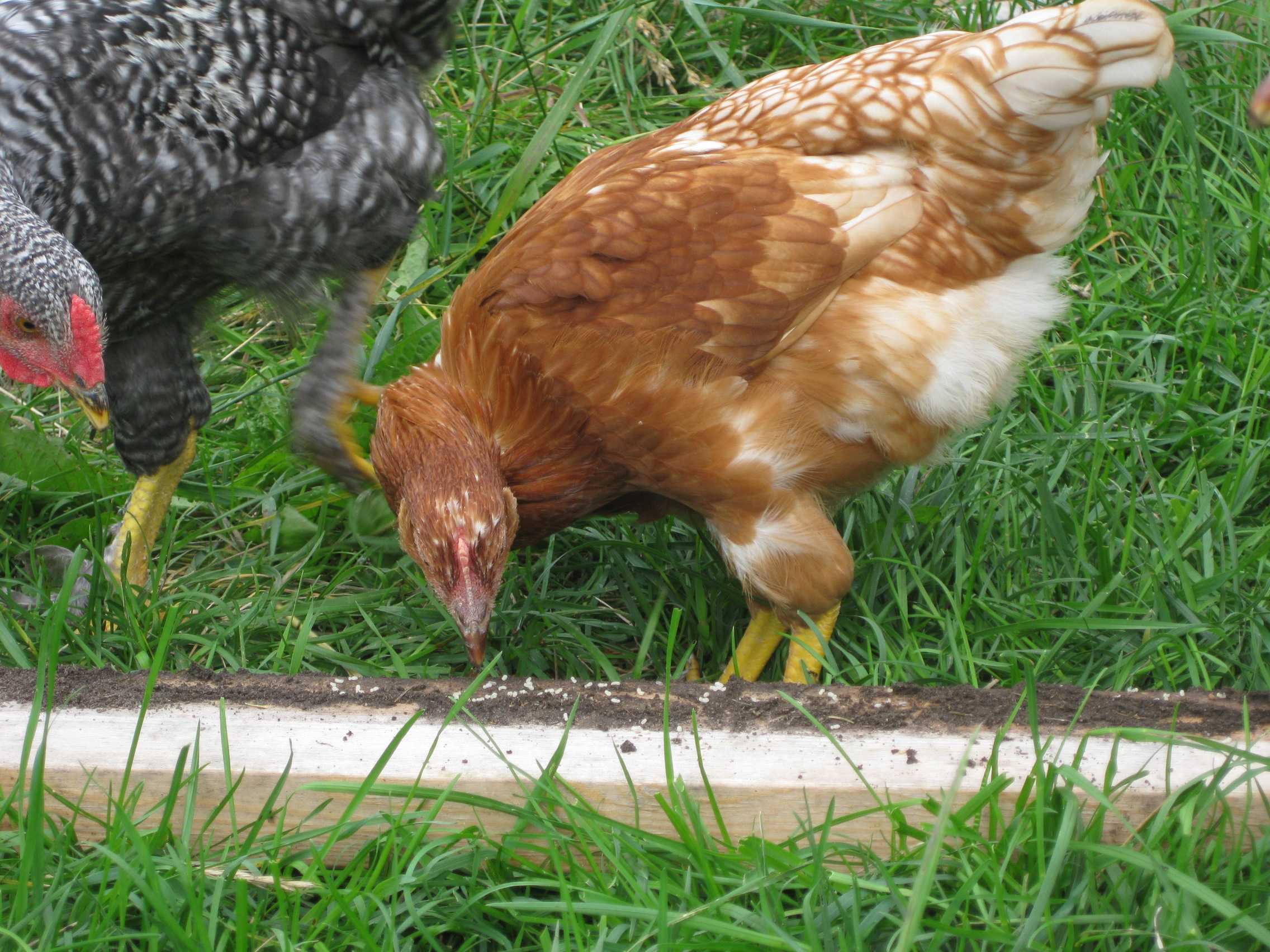
Here is a photo of my chickens eating ant larvae off of a 2X4 that was flipped over for them. They ate all the larvae within a few minutes and provided a stunning display of chicken beak dexterity in doing so. The poor ants were packing up their larvae and hauling off as fast as they could but they didn’t stand a chance. The chickens will be laying any day now. In fact, I think they may be already but I haven’t found their nesting spot yet. And did I mention that Harvey is a rooster? He started crowing a couple weeks ago and confirmed my growing suspicions. He’s the black-and-white one in the photo.

Those are all my updates for now; I’ll take some more photos to share soon.

Grab bag deliveries

On Wednesday I extracted the first of my honey! It is the palest white clover honey with the most delicate flavour. I can’t take much credit for it because the bees did all the work. But I have kept it completely natural, meaning it has not been heated to destroy all the beneficial enzymes and unique flavour. To my knowledge, nobody in my area sprays their fields with any chemicals either, so you don’t need to worry about any foreign pesticides or herbicides in this honey. Natural honey will crystallize eventually but heating it will return it to a liquid. Besides, honey this good won’t stick around long enough to crystallize!

Which brings me to a change in my delivery methods. One of my customers suggested I should deliver food boxes, rather than asking people to order individual items. I am now accepting orders for $15 or $30 food boxes. I’ll deliver to your house if it’s in a convenient location. You can exchange items as you desire once I am at your curb. This simplifies the ordering process. My delivery days are Wednesdays and Fridays and please place your order the day before. Call me- 922.7166 because I don’t check email regularly.

The boxes may include of carrots, summer squashes (patty pan and zucchini), lettuce, beets, turnips, onions, chard, kale, arugula, radishes,and mustard greens. Peas, beans, and snow peas will be available shortly. Potatoes, tomatoes, cucumbers, pumpkins and maybe the odd eggplant will be available later in the season.

Vegetables Available

I now have vegetables available! You can become a member of Locavoria to obtain them or you order directly from me. My delivery day is every Wednesday. I will arrange a pick-up location in the University/Whyte Ave area.

What I have available:
Arugula
Baby beet greens
Baby chard
Kale
Baby lettuce:
Green Zucchini, about 5 inches long
Yellow patty pan squash, about 2 inches in diameter

Please let me know by Monday afternoon by email what you would like. If you are placing an order on Tuesday, please call because I will not be checking email.

I look forward to providing food for you!

Cow manure!

In all the drama of my honey bees and chickens, I almost forgot about the vegetables! Vegetables are the main reason why The Beanstalk has a website so I figured I’d better plant some. My tractor was in the shop for almost a month and it delayed my planting. So did the heaps of rain we got all spring. Like most areas around Edmonton, the soil I’m growing with has a lot of clay in it. This is good in that it sucks up and retains water in an amazing manner, but after heavy rains it takes a while for it to dry out enough for me to till without ruining the soil structure. But the soil has dried out and I’ve planted all the tasty veggies now, and now I have a bit of time to update this website.

But wait, emerging seedlings aren’t the most interesting photos subjects. Instead, let me tell you about the diversity of animals around my compost piles. There are the wasps and frogs around my lawn clipping and leaf compost pile. There’s the dog and yellow-bellied sapsucker woodpecker obsessed with my horse manure/mushroon compost. The dog I can understand. But the woodpecker? There must be something interesting in there.

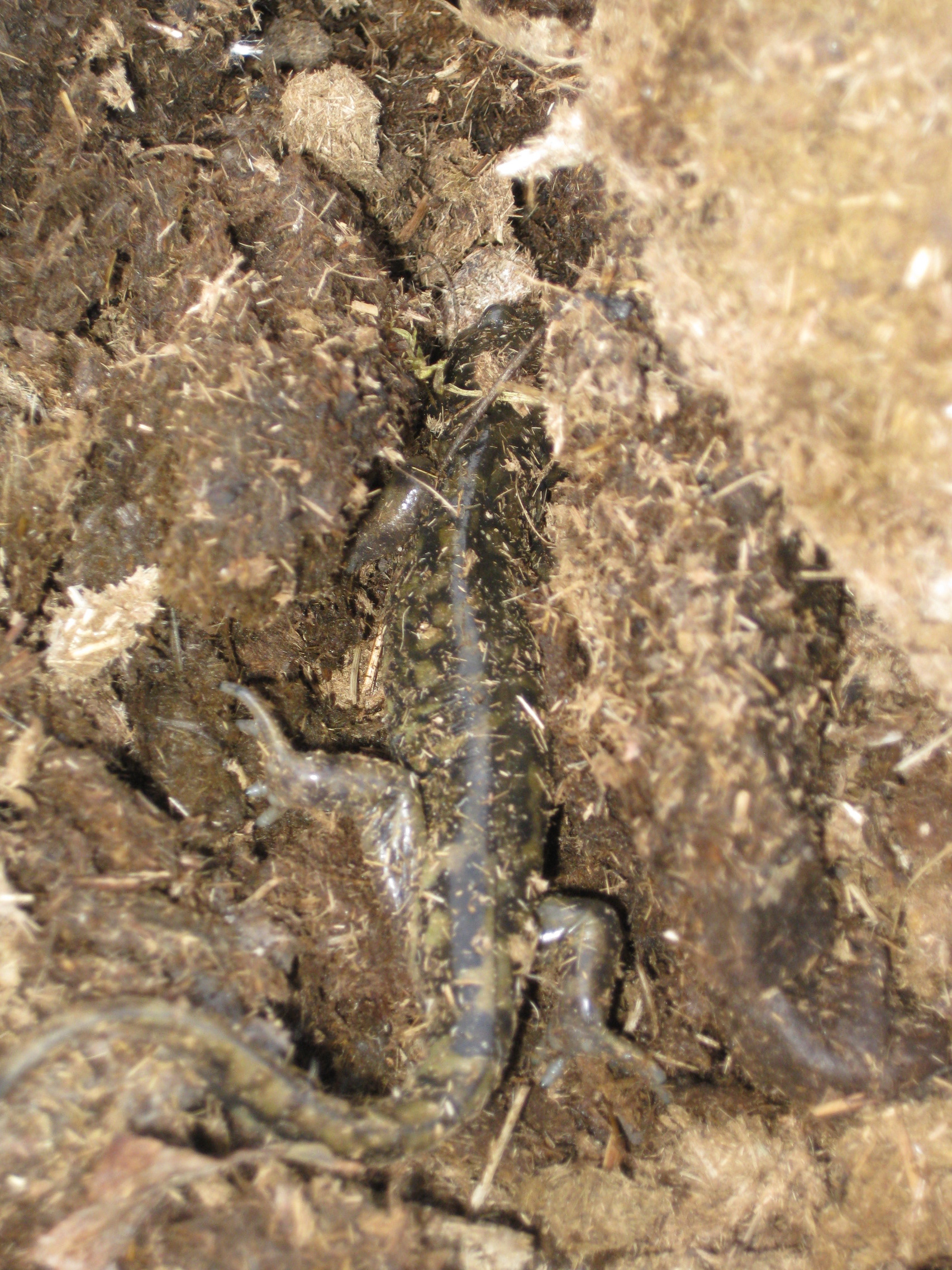
But the most biologically diverse compost is the cow manure. I picked the cow manure up from the pastures (yes, I felt very peasant-like doing this) so we’re not talking cow manure/feedlot slurry here, we’re talking about a dried, almost peat-like cow manure that’s been self-composting out in the fields for a year. There are lots of larvae of various insects living in it, and a tiger salamander! It didn’t like having it’s photo taken very much, but here it is.

It's about the best photo I managed to get.

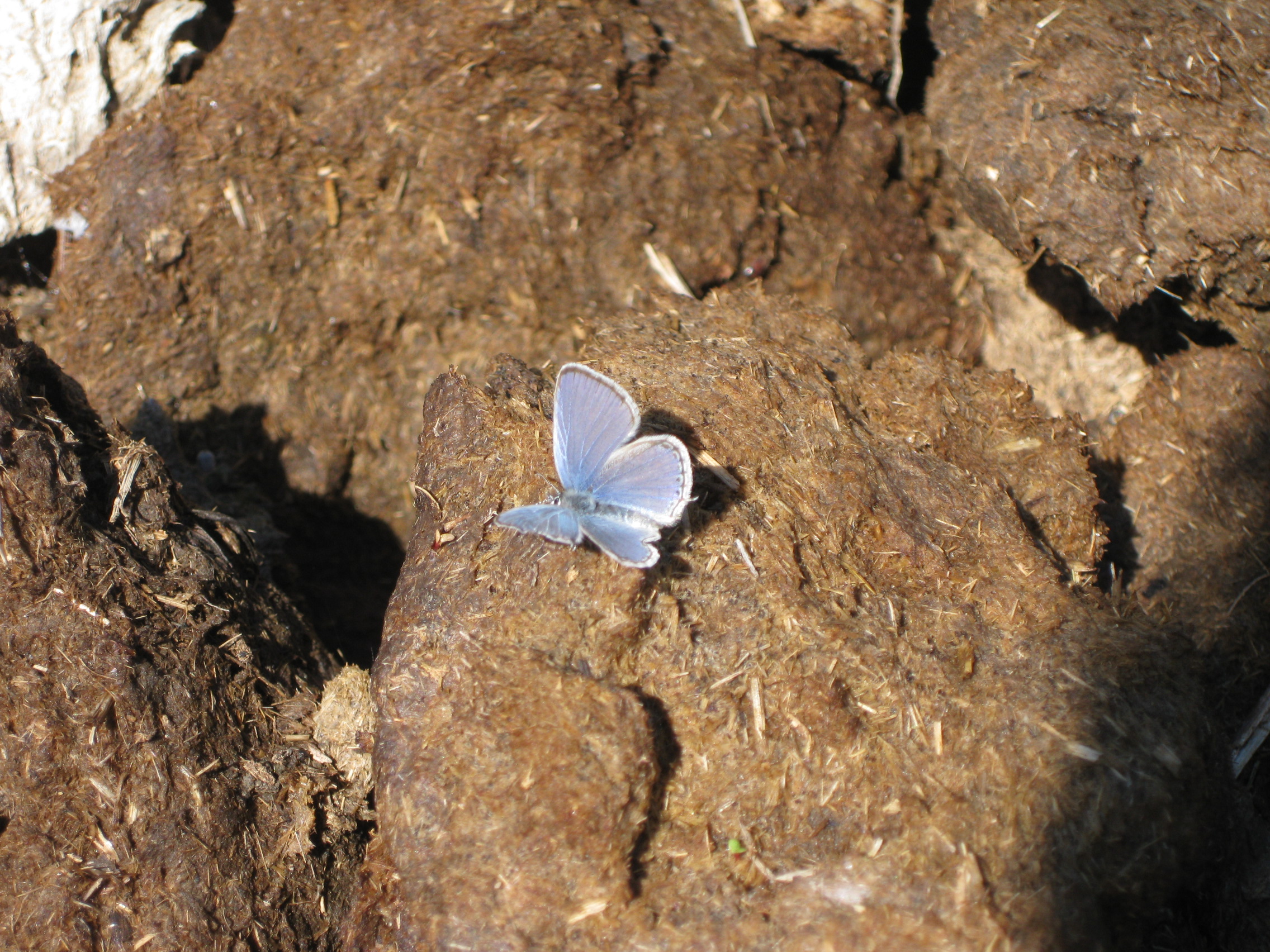
I don’t know if I collected the salamander when I collected the cow pies or if (s)he made it there alone, but the compost pile is now being watered consistently to make sure the salamander, rather than the manure, doesn’t dry out. The western-tailed blues have also been near constant visitors to the cow manure pile as well.

Western tailed blue

Although not related to compost biodiversity, the other discovery was bats in the old garage doors! I’ve been hearing scritch-scritch-scruffles up there for a couple days, but I didn’t have the courage to climb up there and stare the noise maker in the face until a few days ago. And what did I have staring back at me but beady little eyes and leather wings! I’ve seen bats flying at night of course, but hunched up during the day in a garage door is another experience entirely. These bats are very tiny, two and a half inches or three inches at most. They might need to have a real bat house made for them because rain falls down into the garage doors and bats probably don’t like rain very much. I credit them to keeping the mosquito population low around my field.

I’ll post photos of the vegetables when they look a bit more interesting!